



Forex Recent promotion

OVX Markets offers a $50 Forex Free no-deposit bonus
01 October 2026
Get a $25 Cash Bonus with XTrade Phone Verification Offer
24 September 2026
Check Eligibility for the $30 No Deposit Welcome Bonus
16 September 2026
XM Forex Trading in India Claim the $50 Bonus
05 September 2026

InnoMP $30 Forex No-Deposit Bonus How to Claim the Offer
01 September 2026
FISG $40 Newcomer Bonus Free Trading Credit
27 August 2026

The Valtex $30 Forex Free Trading Credit Bonus
26 August 2026

EMAR Markets $50 Welcome Bonus Guide for New Traders
11 August 2026

Join The Valetax Wondervault Trading Contest Today
10 August 2026

What Are Trading Signals, How They Work and If They Pay Off
A trading signal is a specific suggestion to buy or sell an asset, usually with direction, entry price, stop loss, and take profit, generated by technical indicators, algorithms, or human analysts. Signals give beginners structure, save screen time, and teach setups, but they guarantee nothing.
Risks include blind dependence, oversized leverage, hidden costs, and providers advertising implausible win rates. Risk-to-reward matters more than win rate: a 1:2 ratio breaks even at roughly 33% wins, though spreads, slippage, and monthly fees raise that bar. Using signals well means checking the timestamp, comparing live price with the entry, sizing each position to risk about 1% of the account from the stop distance, and deciding the exit beforehand, perhaps moving the stop to breakeven later.
Example setups include moving average crossovers, oversold RSI, and resistance breakouts, each with built-in weaknesses, and the best signals match what you can see on your own chart. To choose a provider, screen for verifiable track records and transparent fees, test at least 30 trades on a demo account, then go live with small risk. Treat signals as a filter and teaching tool, not an income plan.
What Are Trading Signals? How They Work and If They Pay Off
You open a trading app, see a chart moving, and a message pops up telling you to buy EUR/USD at 1.0850. That message is a signal. If you are asking what are trading signals, you are probably wondering whether you can trust one with real money.
A trading signal is a specific suggestion to buy or sell an asset, usually with an entry price, a stop loss, and a take profit level. Signals come from three places: technical indicators, automated algorithms, or human analysts. Traders use them to time entries and exits instead of staring at charts all day. Whether they pay off depends on who produces the signal and how you manage risk. Signals do not guarantee profit.
This article explains what signals are in trading, how each type is generated, and how to read one. It also covers the common pitfalls that make traders lose money, including paid services that promise too much. At fxnewinfo, we track free signal offers and broker bonuses, including how to select the best free forex signals, so we will also show you how to test signals safely on a demo account or with a no deposit bonus before you risk your own capital.
Why trading signals matter to beginner traders
The problem signals try to solve
Most new traders fail for boring reasons. They enter late, skip the stop loss, or close a winner too early because a moving chart makes them nervous. A signal hands you a ready-made plan before the trade starts, so you are not improvising while price moves against you.
Time is the other obstacle. Forex trades 24 hours a day, five days a week, and you cannot watch the London open and the New York session while holding a day job. Automated alerts watch the market for you and ping your phone when a setup appears. That is the practical answer to what are signals in trading for a beginner: a way to borrow structure and attention you do not have yet.
What a good signal gives you
A well-built signal removes guesswork in four areas. If any of them is missing, treat the signal as incomplete and do not trade it until you have filled the gap with your own analysis and a defined risk limit.
|
Element |
What it tells you |
Example |
|---|---|---|
|
Direction |
Buy or sell |
Buy EUR/USD |
|
Entry |
Where to open the trade |
1.0850 |
|
Stop loss |
Where the idea is proven wrong |
1.0820 (30 pips of risk) |
|
Take profit |
Where to bank the gain |
1.0910 (60 pips of reward) |
That example risks 30 pips to make 60, a 1:2 risk-to-reward ratio. Knowing this number before you click is worth more than the entry price itself, because it tells you how often you need to be right to come out ahead.
Beyond the trade itself, signals teach you. When a provider explains why a signal fired, you see how support levels, moving averages, and RSI readings feed a decision. After a few weeks of reading those explanations, you start spotting the same setups on your own charts, and that builds real skill faster than guessing.
Where beginners get hurt
Dependence is the biggest risk. A signal feels like a shortcut, so new traders follow it blindly and stop thinking. No signal wins every time. A solid strategy might win only 45% to 55% of its trades, and that is fine if winners are twice the size of losers. A provider that advertises a 95% win rate is almost always hiding something, such as tiny take profits paired with huge stop losses.
A signal is a trade idea, not a promise, and your risk management decides whether it pays.
Leverage makes the damage worse. If you copy a signal with an oversized lot on a 1:500 account, one losing trade can erase most of your balance. A simple rule keeps you alive: risk no more than 1% of your account on any single signal, and size the position from the stop loss distance, not from how confident the message sounds.
Finally, cost matters. Paid services often charge $30 to $100 a month, and that is a lot of overhead on a $200 account, while some brokers hand out free forex trading signals from LegacyFX at no cost. This is why testing on a demo account or with a small free no deposit bonus in forex trading comes first, before you pay anyone or risk your own money.
How trading signals are generated and what they contain
Every signal starts as either a rule or a judgment call. Knowing what trading signals are built from tells you how much to trust them, because the source matters more than the packaging.
The three sources behind a signal
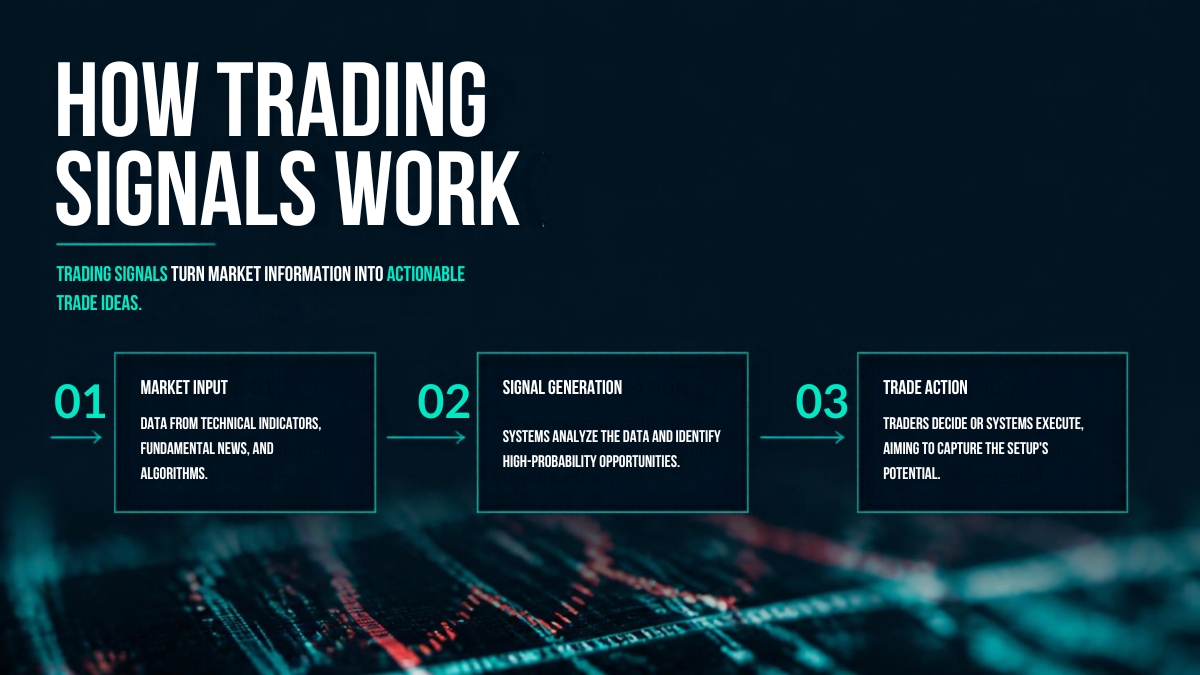
The simplest signals come from technical indicators. A moving average crossover or an RSI reading below 30 fires an alert the moment the math says so. Algorithms stack many of those rules, add inputs like volatility and news timing, and run them without emotion. Human analysts read charts and fundamentals, then post a trade idea with their reasoning attached.
|
Source |
How it fires |
Main strength |
Main weakness |
|---|---|---|---|
|
Technical indicators |
Preset rule, such as RSI below 30 |
Transparent and often free |
Many false alerts in choppy markets |
|
Algorithms |
Coded rules across many inputs |
Fast, consistent, runs 24/5 |
Can break when market conditions change |
|
Human analysts |
Chart and news judgment |
Context and explanation |
Subjective and hard to verify |
What a complete signal message contains
Beyond direction, entry, stop loss, and take profit, a solid message carries extra details that let you check the idea before you act. Look for these:
-
Instrument and timeframe: EUR/USD on the H1 chart is a different trade from EUR/USD on the daily.
-
Time issued and expiry: a signal posted at 08:00 may be stale by 10:00.
-
Order type: a market order fills now, while a buy limit waits for price to come to you.
-
Suggested risk: a percentage of your account, not a fixed lot size.
-
Rationale: one line on the setup, such as a bounce off support with RSI turning up.
Timestamps matter most. Without one, you cannot compare the signal with the actual price action afterward, so you cannot tell whether the provider's results are real or edited after the fact.
A signal you cannot verify after the fact is a signal you cannot trust.
So before you follow anything, run a quick check. Confirm the message names a source or method, shows a time, and gives a stop loss. If it only says "Buy gold now, huge move coming," skip it. That is a hype message, not a signal.
How to use trading signals to time entries and exits
Knowing what trading signals are is only step one. Using them well comes down to a short routine you repeat on every trade, and the routine matters more than the signal. Skip it and even a good call can lose you money.
Timing the entry
Never fire the order the second a message arrives. Price keeps moving after the timestamp, so compare the live price with the signal's entry first. If the signal says buy EUR/USD at 1.0850 and price is already at 1.0865, your stop is now 45 pips away and your target only 45 pips. The 1:2 ratio has become 1:1, and the trade is no longer the one the provider designed.
Run this checklist before you click:
-
Check the timestamp and expiry. If the signal is hours old, skip it.
-
Compare the live price with the entry. On an H1 signal, skip it if price has drifted more than 5 to 10 pips.
-
Size the position from the stop distance, risking 1% of your account.
-
Attach the stop loss and take profit to the order itself.
-
If price has not reached the entry yet, use a buy limit or sell limit instead of a market order.
Managing the exit
Exits decide the result, so settle yours before you enter. The signal's stop loss and take profit are your starting exit plan. Do not widen the stop because you hope price will come back. That one habit turns a 1% loss into a 5% loss faster than any bad signal can.
Decide your exit before you enter, because the market will not do it for you.
Once the trade moves in your favor, you can adjust. When price travels as far as your original risk, move the stop loss to breakeven. Some traders also close half the position at a 1:1 gain and let the rest run to the target. Both tactics trade a little profit for a lot of protection. Log every signal you take, with entry, exit, and result, so after 30 trades you can see whether the provider actually helps you.
Trading signal examples you can recognize on a chart
Theory only goes so far, so look at what signals look like on a real chart. These three setups answer what are trading signals in practice, because each one is a simple rule you can spot yourself.
Three indicator signals beginners see most
|
Signal |
What triggers it |
Trade idea |
Common failure |
|---|---|---|---|
|
Moving average crossover |
The 50-period average crosses above the 200-period average |
Buy |
Whipsaws in sideways markets |
|
RSI oversold |
RSI(14) falls below 30, then turns up |
Buy |
Stays below 30 in strong downtrends |
|
Resistance breakout |
Price closes above a level that rejected it before |
Buy |
False breakouts that reverse within hours |
Notice that every rule has a built-in weakness. Crossovers lag, so you often enter after half the move is gone. An RSI below 30 does not force a bounce, and in a steady downtrend it can sit there for days. Flip each rule upside down and you get the matching sell signal.
A full example from alert to trade
Picture EUR/USD on the H1 chart. Price slides to 1.0820, a level that held twice last week. RSI(14) reads 28, then a bullish candle closes at 1.0850. A provider posts: buy at 1.0850, stop loss 1.0820, take profit 1.0910. That is the same 1:2 setup from earlier, now tied to real price action.
Three things line up here: a visible support level, an oversold reading, and a candle that confirms the turn. Traders call that agreement confluence. It makes this signal stronger than an RSI alert alone, and it gives you a logical place for the stop, just below the level that must hold.
The best signals match something you can see on the chart yourself.
Signals that should make you pause
Some messages look like signals but fail the chart test. Open your platform and check before you trade. Skip or question a signal when you see any of these:
-
The entry sits far from the current price, with no explanation.
-
The stop loss is missing or wider than the take profit.
-
The trade fights the daily trend, such as a buy into a steep drop, with no stated reason.
If you can draw the level, the indicator reading, and the stop on your own chart, the signal passes. If you cannot, you are trusting a stranger's word instead of a setup.
Do trading signals actually work?
Sometimes, but not the way most ads suggest. A signal can point to a real edge, yet the signal alone never decides the outcome. Your position size, your costs, and your discipline decide it. Treat any promise of steady profit as a red flag.
What the math says
Win rate means little without the reward-to-risk ratio. A strategy that wins only 40% of its trades still makes money at 1:2, while a 70% win rate loses money if the average loser is three times the size of the average winner. This table shows the break-even win rate for each ratio, before costs.
|
Risk-to-reward |
Break-even win rate |
|---|---|
|
1:1 |
50% |
|
1:2 |
33% |
|
1:3 |
25% |
Then subtract costs. Spreads, slippage, and a $50 monthly fee all raise the bar. On a $500 account, that fee alone is 10% a month, so the signals must beat it before you earn a cent of real profit.
Why real results often disappoint
Delay hurts first. By the time a message reaches your phone, price has moved, and the 1:2 setup may already be 1:1. Providers also show screenshots of winners, and a handful of picked trades proves nothing. Markets change too, so an algorithm that thrived in a strong trend can bleed in a sideways range.
Behavior finishes the job. Traders skip the losing signals, double their lot size after a loss, or move stops. The numbers back this up. Brokers regulated in the EU must publish the share of retail CFD accounts that lose money, and it usually sits between 70% and 80%. Signals do not change that figure on their own.
Signals can improve your odds, but only a tested edge and strict risk control turn them into profit.
A fair verdict
So what are trading signals really worth? They work well as a filter and a teaching tool. They show you setups, force you to plan the exit, and save screen time. They work poorly as an income plan, especially when you pay for them on a small account. Run any provider through at least 30 demo trades and log the results before you spend a dollar or risk your own capital.
How to choose and test a signal provider safely
Asking what are trading signals is the easy part. Picking a provider is harder, because anyone can open a Telegram channel and call themselves an analyst. Your job is to screen first, test second, and pay last. Many providers offer a free tier or a trial, such as the free OctaFX trading signals, and a demo account costs nothing, so you can learn a lot before spending a dollar.
Screen the provider before you follow anything
Start with the offer itself. Reputable providers publish a verifiable track record with timestamps, and they show losing trades next to winners. Walk away at the first sign of guaranteed profit, because no honest provider can promise one.
Run through this checklist:
-
Every signal includes direction, entry, stop loss, and take profit.
-
Results come from an independent, third-party verified account, not screenshots.
-
Fees are stated up front, with a free trial or refund window.
-
The provider never asks for your trading password or pushes you to deposit with one specific broker, so pick your own from a guide to trusted forex brokers and safe trading.
-
Losses are posted openly, and the win rate claims stay believable (below 70%).
Missing even one item is reason enough to pass.
Test it on a demo account first
Once a provider clears the screen, copy its signals on a demo account for at least 30 trades. A free signal channel or a no deposit bonus that lets you trade without risk works too, since that way you trade real market conditions without touching your own savings.
-
Log the signal time, the entry price you actually got, the exit, and the result.
-
Skip any signal that arrives after price has drifted from the entry, exactly as you would live.
-
Subtract spreads and the monthly fee from your total.
-
Check the worst losing streak and the biggest drop in your balance.
-
Repeat for a second week if the sample feels thin.
Never pay for a signal service until it has passed your own demo test.
Decide, then go live small
Pass the provider only if your demo results are positive after all costs and the largest drawdown stayed under about 10%. A winning week proves nothing, so look at the full sample. If the numbers hold, go live with 0.25% to 0.5% risk per trade for a month, well below your usual 1%. Raise the size only when live results match the demo. If they do not, drop the provider and move on.
Putting trading signals in perspective
Signals are trade ideas, not promises. Whether they come from an indicator, an algorithm, or an analyst, a good one gives you direction, entry, stop loss, and take profit, and you can verify it on your own chart. They work best as a filter and a teaching tool, and they only pay off when strict risk control sits behind them.
That is the honest answer to what trading signals are worth. Check the timestamp, size every position from the stop, and log your results. Run any provider through 30 demo trades and decide before you pay or risk real money.
Ready to practice without risking your own savings? Browse the ultimate list of forex no deposit bonus offers at fxnewinfo, pick a broker, and give your next signal a real test.
Add Your Comment
Comment(0)
Forex No Deposit Bonus

$100 Forex No Deposit Bonus Offer by Best Broker
29 January 2024

New $30 No Deposit Forex Bonus at JustMarkets Today
19 November 2021

No Deposit New Bonus $500-$1500 at InstaForex for Trading
24 October 2021

Money Never Sleeps Fx Trading Contest
12 October 2016

Get a $50 hi account for free from CWG
20 October 2021
Headway $111 New Withdraw-able Non Deposit Bonus
22 March 2022
$100 Free Forex No Deposit Bonus Powered by ForexChief
17 September 2021

InstaForex Free $500 Bonus on No-Deposit Forex Trading
24 August 2022















Comments (0)